As a bit of background, I have been to a few XMPP stands organised by others, at FOSDEM and FrOSCon, seeing their strengths and where I felt they were weaker. This was my first attempt at organising a stand, and to my surprise it was more successful than I could have ever dreamed of.
We had a large proportion of the conference come over and chat, not just take stickers, and leaflets like many other stands at other conferences, but full on indepth discussions, which inevitably led to the XMPP stand becoming a hackerspace of sorts, the organisers suggesting we pull more tables over to the end so that people could hack at the end of the stand and not block the main stand.
We also trialled some new ideas, which I haven't seen at any other stands so far. I will also cover the ideas which are common at every stand.
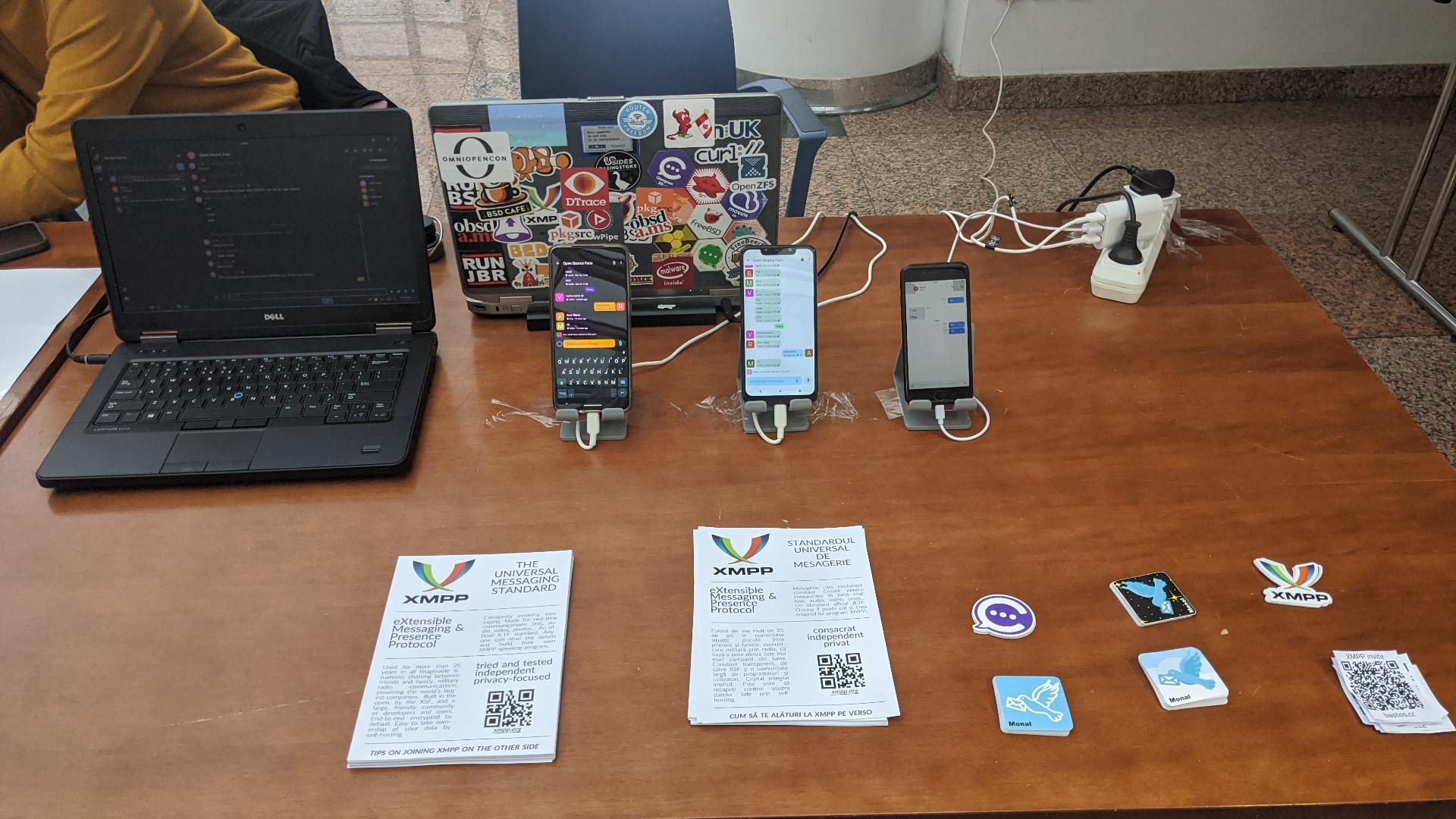
Like every stand, we had stickers. This in my opinion doesn't really help too much with getting people interested in XMPP, most people end up throwing stickers into a box at home. This doesn't mean they are a waste of time, people who are passionate about XMPP love to be able to decorate their devices with stickers, which then helps with making XMPP more mainstream and familiar.
para designed new leaflets for the conference, these were more popular than the stickers for newcomers, because it explained exactly what XMPP is, and on the back explained how to try XMPP, even the organisers of the conference were taking a look at the leaflets, and could potentially play with XMPP in the future.
Leaflets are also ridiculously cheap to print (compared to stickers) making them much more disposable, allowing you to spread XMPP to more people for less.
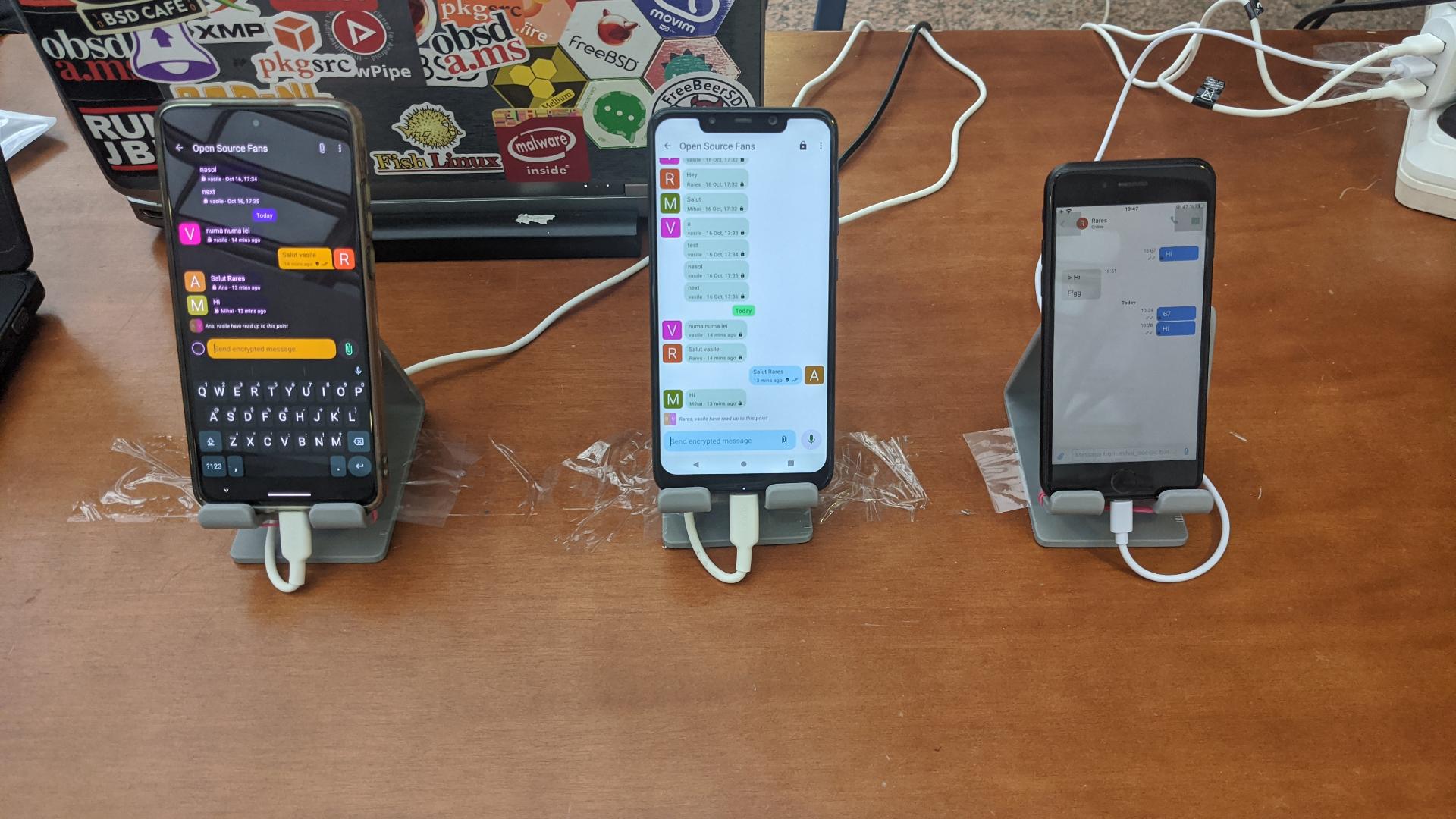
The device demos we picked were to target the most platforms possible, so that anyone who came over to the stand could see the interop between different clients and devices. We had an iphone with Monal IM, two androids with conversations and cheogram and a linux laptop with gajim (which would also run on windows as well).
As with all conferences, the device demos were popular, and people like playing with them. However they are much more of a "woah cool" rather than a method of getting people onto XMPP.
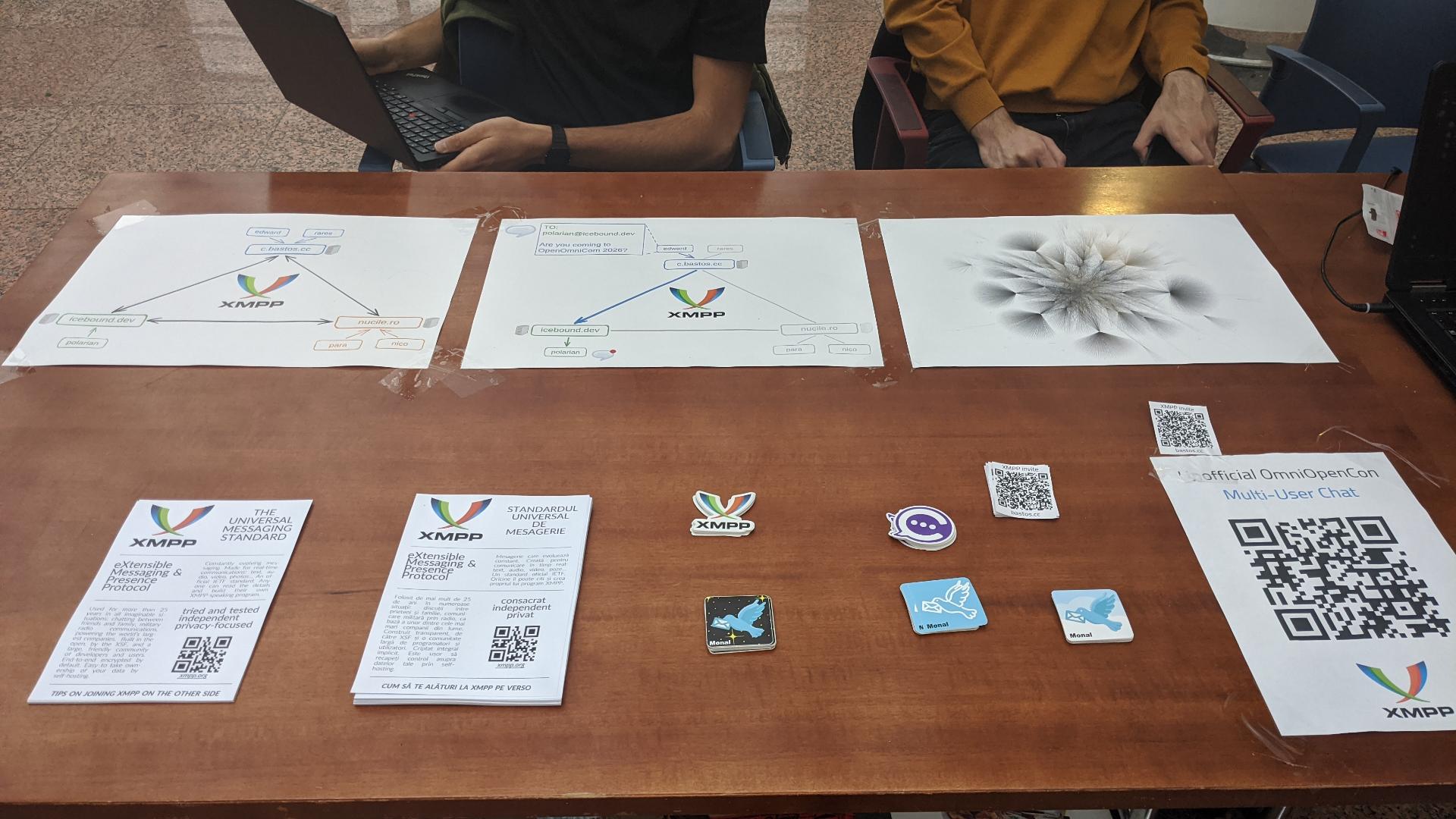
Edward designed two example diagrams showing at a high level how servers federate, and users message across different servers. This also was invaluable in my talk to describing how the XMPP protocol functioned. These diagrams made it far easier to explain to people who were less tech savvy how XMPP is beneficial to them, and why it would suit their use case.
On top of this, para had rendered an A3 image of the XMPP operators graph, as this is so big and hard to render on the web that under conference conditions its hard to have it on hand. Having it printed on paper allowed us to use it as a high level overview of how many servers (which publish themselves) are federating within the network, with the protocol diagrams being a "slice" of that network.
I have not yet seen this as at any stand personally. I have seen the use of a demo MUC hosting on hardware at the conference, but not an actual public MUC with a QR code for people to join as they walked past the stand.
This was probably the most successful part of the stand, those who already used XMPP or had dabbled in it came past and joined the MUC and were chatting throughout the conference, and even days later theres been regular activity after the conference. This has allowed people to make new connections, which is something XMPP has always struggled with providing due to the limited number of communities outside of XMPP development.
We printed the XMPP URI off as a QR code stuck it in the middle of the stand.
We had two operators (other than myself) who were at the stand. We had already decided in advance to try to break the cycle of people coming over, speaking and then forgetting about XMPP, that we would hand out invite links along with the leaflets they could collect, so they could easily install the app on their phone at the stand, and scan a QR code, make a username and then immediately join the MUC.
This had some success, some people still decided to use random providers as is their freedom to, but we also saw a few people sign up via the invite links.
The invite links were printed off and then cut up into sticker-size QR codes which people could take away with them.
Unfortunately, due to a mistake, half way through the day the invite link was invalidated, and all the invite links distributed in the morning had to be discarded. For this reason, we can not draw a definite conclusion whether this method of onboarding is actually successful or not. Better luck next time.
Unfortunately I was given the last talk slot before the closing notes. This meant a lot of people had already left by the time my talk was up, and I don't feel like it properly reached the audience I intended. The talk was focused at sparking interest in XMPP, rather than a deep dive into some topic within XMPP. However the majority of the audience already used XMPP.
Nevertheless, it was a fun talk, and at the bare minimum I got to thank everyone who had been involved in making the stand possible.
The stand was definitely the highlight fo the conference, it drew many more people towards it, and was far better at onboarding and getting new people interested in XMPP.
You can see the slides here.
Most talks are just people standing at the front speaking about something for the allotted time, however we instead handed out XMPP leaflets, and invite links to everyone who attended. This provided them with the information to go away after the talk and look into it more if they were interested.
Due to the few people who attended the talk, I can't say if this would be effective if scaled, but 1-2 people who attended my talk and got the leaflet ended up making an account and messaging me after the conference, so at the limited scale I had, it was successful.